
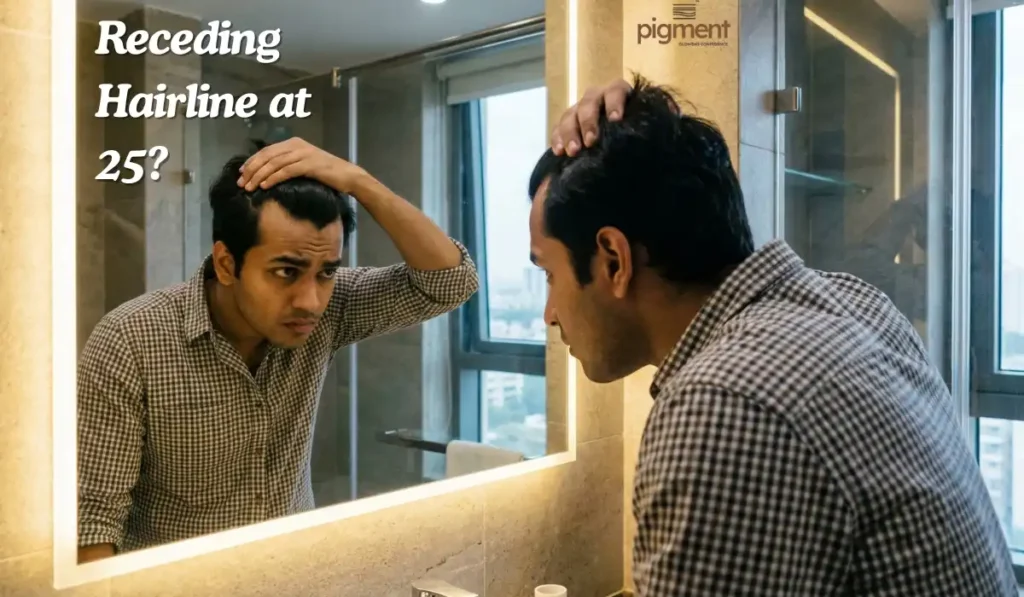
It starts with a quick glance in the bathroom mirror under those harsh fluorescent lights. Maybe you were washing your face after a long shift at the office, or maybe you saw a photo of yourself from a weekend trek to Nandi Hills.
Suddenly you notice it. The corners of your forehead look deeper than they used to. The hair around your temples is thinner. When you pull your hair back, you see a distinct “M” shape forming.
Panic sets in because you are only 25. You are not supposed to be losing hair yet.
If this sounds familiar, you are not alone. At Pigment Skin & Hair Clinic, we are seeing a massive surge in young men, specifically those in the IT and startup sectors, walking in with early signs of balding.
Is it the water quality? Is it the stress of the Outer Ring Road traffic? Or is it just bad genetics?
Here is the honest truth about why you are losing hair early and the specific treatments that can stop it before it becomes irreversible.
Diagnosis: Am I Balding or Just Growing Up?
Before you spiral into panic, you need to understand the difference between a “Mature Hairline” and a “Receding Hairline.”
The Mature Hairline (Normal)
Between the ages of 17 and 25, almost every man’s hairline changes. It is normal for your hairline to move back about 1 centimeter from where it was when you were a teenager. If the line moves back slightly but remains defined and thick, this is just your face maturing. You do not need treatment for this.
The Receding Hairline (Requires Action)
This is different. You know it is a problem if you see the following signs:
- The “M” Shape: The recession at the temples is deep and obvious.
- Miniaturization: The hair behind the hairline isn’t thick. It looks wispy, thin, and colorless.
- The Vertex: You are also seeing a thinning patch on the crown or back of your head.
If you are seeing these signs, you are likely dealing with Male Pattern Baldness (Androgenetic Alopecia).
Not Sure If It’s Genetic?
Don't guess with your hairline. Send us a photo of your temples privately on WhatsApp, and our experts will help you understand if it’s a "Mature Hairline" or the start of Male Pattern Baldness.
Chat with an Expert: Check My HairlineThe Science: Why “Onion Oil” Won’t Save You
Most men in Bangalore waste the first 12 months trying to fix this with anti-hair fall shampoos, onion juice, or expensive serums they saw on Instagram.
These rarely work because they do not target the root cause.
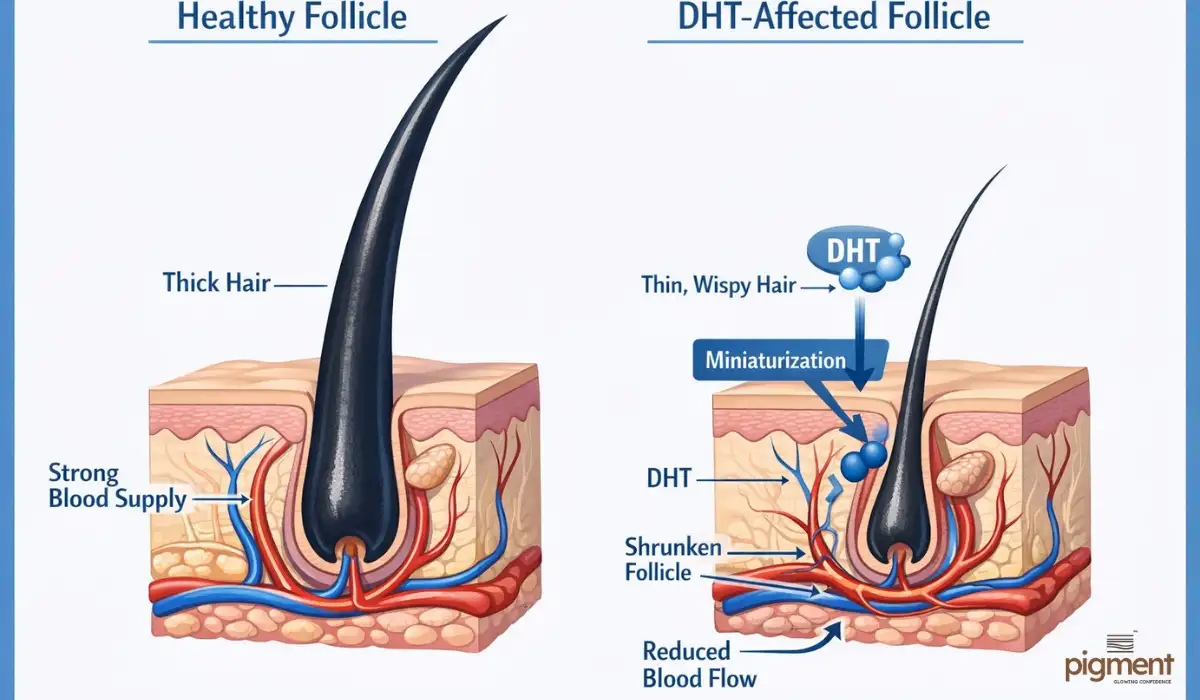
The villain here is a hormone called DHT (Dihydrotestosterone).
If you have the gene for balding, DHT attaches to your hair follicles and slowly chokes them. It forces the follicle to shrink until it can no longer produce hair.
The Bangalore Accelerators
While genetics load the gun, your lifestyle pulls the trigger. In Bangalore, three specific factors are hitting the fast-forward button on your hair loss:
- High Cortisol (Stress): Working in high-pressure startup environments or night shifts spikes your cortisol. Stress pushes hair into the shedding phase which makes genetic balding happen faster.
- Nicotine & Vaping: A common habit in tech parks. Nicotine constricts blood vessels which literally starves your hair roots of oxygen.
- Metabolic Chaos: Irregular eating hours and lack of sleep disrupt your body’s repair cycles.
“But what about the hard water?”
We hear this every day. Yes, hard water damages the texture of your hair and causes breakage. However, hard water does not cause male pattern baldness or root loss. It is crucial to distinguish between simple hard water hair fall and actual genetic thinning so you don’t waste time treating the wrong problem.
The Best Male Pattern Baldness Treatments in Bangalore
You cannot change your DNA, but you can block the mechanism that kills your hair. Here are the two most effective paths we use at Pigment Skin & Hair Clinic.
Option A: The “Natural” Booster (GFC Treatment)
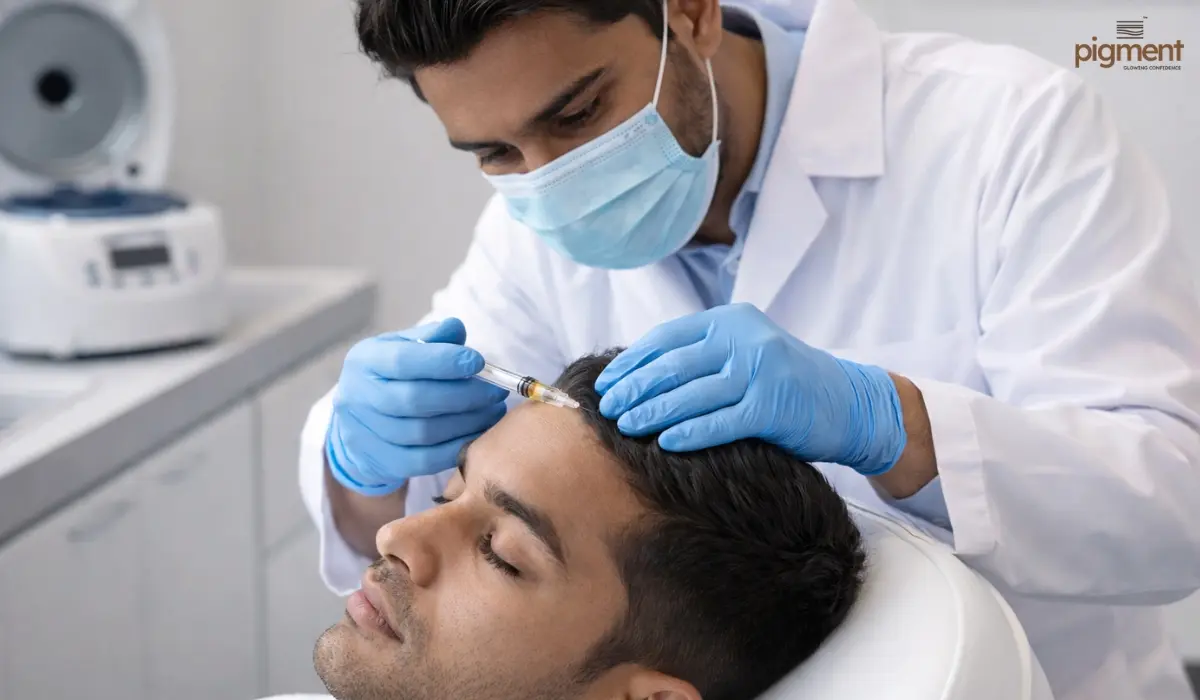
For men who want to avoid daily pills or chemicals, Growth Factor Concentrate (GFC) is the new gold standard.
Unlike older methods, GFC is a highly concentrated engineered preparation made from your own blood. We inject your own growth factors directly into the thinning areas.
- Why Techies Love It: It is a quick procedure that takes only 30 minutes. It is completely natural and has zero sexual side effects.
- The Result: It wakes up dormant follicles and thickens the thinning hair to reverse early-stage recession.
If you are wondering how this compares to traditional methods, you should understand the difference between PRP and GFC hair treatment before booking your session.
Option B: The Medical Route (Finasteride & Minoxidil)
These are the FDA-approved heavy hitters.
- Minoxidil: A topical solution that increases blood flow to the scalp.
- Finasteride: An oral medication that blocks DHT.
The “Libido” Fear
Let’s address the elephant in the room. Every guy searches to see if male pattern baldness treatment reduces libido.
Here is the medical reality. Sexual side effects from Finasteride affect less than 2% of men. For the vast majority, it is perfectly safe. However, you should never buy this over-the-counter. You need a Dermatologist to prescribe the correct dosage and monitor you to ensure you stay in the safe zone.
Can “Natural Remedies” Stop the Receding?
We often see patients asking for a male pattern baldness natural treatment.
While Ayurveda (Bhringraj, Amla) and oils (Rosemary) are excellent for scalp health and conditioning, they are generally not strong enough to stop DHT from attacking a genetically sensitive follicle.
Use natural remedies as a support system, like taking vitamins, but do not rely on them as your primary defense against genetic balding. You will lose precious time.
Styling: Looking Good While You Treat

While you are waiting for your treatment to kick in, which usually takes 3 to 6 months, you need to look sharp today.
The #1 Mistake: The Combover. Trying to grow your hair long to cover the bald spots usually backfires because it makes the thinning look obvious and desperate.
The Fix: Go for a Textured Crop or a Buzz Cut.
A buzz cut projects confidence. By reducing the contrast between your hair and your forehead, it actually makes the recession less noticeable. You can also balance your face by growing a well-groomed beard. We often recommend laser hair removal for men to define the cheek lines and neck, making your jawline look sharper and more deliberate.
Conclusion: Time is Follicles
Here is the harsh reality of hair loss. It is much easier to keep the hair you have than to grow back hair you’ve lost.
Once a hair follicle is dead and the skin becomes shiny and smooth, no amount of GFC or Minoxidil will bring it back. At that point, your only option is a hair transplant.
You have a window of opportunity right now while the hair is thinning but still alive. Do not let hesitation cost you your hairline.
Save Your Hair Before It’s Gone
You have a limited window to reverse the thinning. Book a consultation today to draft a GFC or Medical strategy that stops the recession.
Book My Hair Loss Strategy SessionFrequently Asked Questions (FAQ)
Q1. Can a receding hairline grow back?
Ans: If the follicle is still alive and producing thin, wispy hair, yes. Treatments like GFC and Minoxidil can thicken it back to normal. If the area is completely smooth and shiny, the hair is likely gone permanently without surgery.
Q2. Is GFC better than a hair transplant?
Ans: They are for different stages. GFC is for prevention and reversal in the early stages of thinning. A Transplant is for restoration in the late stages where you have bald spots. Using GFC early can prevent you from ever needing a transplant.
Q3. Does wearing a cap cause hair loss?
Ans: No, this is a myth. Unless your cap is so tight it is cutting off circulation, which would be painful, wearing a hat does not cause male pattern baldness.
Q4. How early should I start treatment?
Ans: As soon as you notice the “M” shape or thinning. The earlier you start, the more hair you save. Starting at Stage 1 or 2 gives you the best chance of full recovery.
Q5. Are there side effects to GFC treatment?
Ans: Since GFC uses your own blood, there is zero risk of allergic reaction or side effects. You might have mild redness at the injection site for an hour, but you can go straight back to work.