
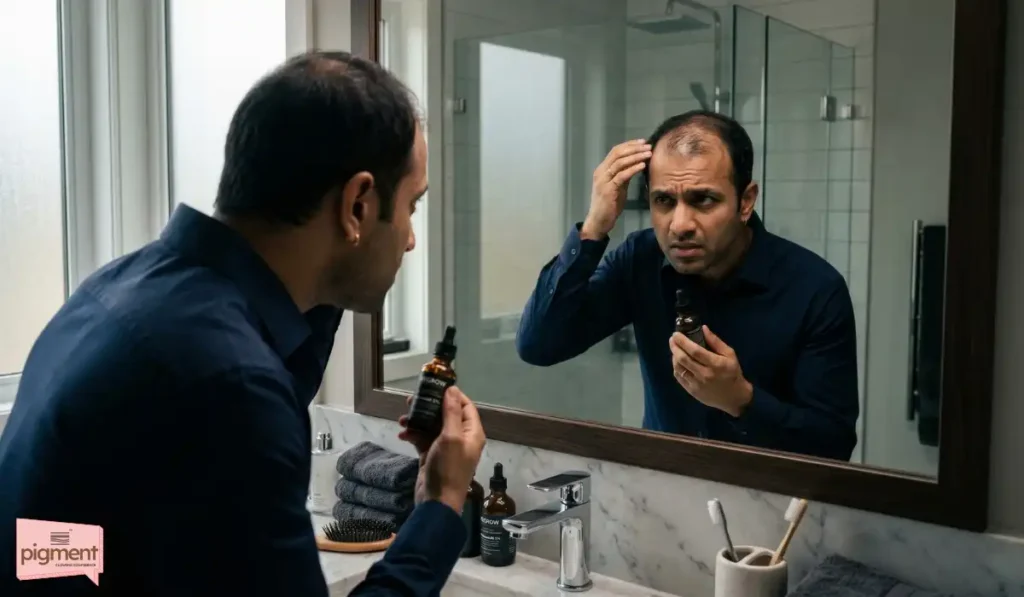
You have been diligently applying minoxidil drops to your scalp twice a day for a year. In the beginning, you saw a massive reduction in shedding and even some exciting new baby hairs. Now, your progress has completely plateaued. You are losing hair in the shower again, and your scalp is becoming visible under harsh lighting. You have hit the topical ceiling. Over-the-counter drops are a great starting point, but they cannot permanently repair a dying hair follicle. As board-certified dermatologists, we transition hundreds of patients away from pharmacy liquids and into clinical therapies every single month. If you are serious about restoring your density, you must understand why topicals fail and when to upgrade to a medical-grade intervention.
The Biology Behind the Minoxidil Plateau
We are writing this section because you need to understand exactly why your daily routine stopped working. Most patients panic when their shedding resumes. They assume their hair loss is untreatable. You must understand that your hair is not immune to treatment. You are simply using the wrong mechanism.
Minoxidil is scientifically classified as a vasodilator. It works by artificially widening the blood vessels in your scalp to allow more oxygen and nutrients to reach the hair follicle. It does not stop the underlying genetic or hormonal attacks on your hair root. Because it only treats the symptom (poor blood flow) and not the root cause, your follicles will eventually build a tolerance.
Clinical data from global dermatological studies proves that minoxidil efficacy typically peaks between 12 and 18 months of continuous use. After this window, the progressive miniaturization of the follicle overpowers the artificial blood flow, leading directly to a growth plateau.
Identifying the Need for a Severe Hair Fall Treatment
You need to know exactly when to stop relying on home remedies and step into a clinic. Continuing to use weak topicals when your follicles are actively dying is a massive waste of time and money.
You must conduct a harsh audit of your daily shedding. If you are losing more than 100 hairs a day, waking up to hair on your pillow, or noticing that your ponytail circumference has shrunk by half, you are dealing with aggressive follicle miniaturization. You must immediately pivot to a severe hair fall treatment. Over-the-counter hair fall treatment oil and cosmetic shampoos cannot penetrate the dermis to rescue a dying root.
In our Bangalore clinic, trichoscopy evaluations consistently show that once a hair follicle miniaturizes past fifty percent of its original diameter, topical solutions completely lose their effectiveness. Only direct injectable therapies can reverse the damage at this stage.
Has Your Hair Growth Stalled?
Stop wasting money on treatments that no longer work. Chat with our board-certified trichologists to find out if you are a candidate for advanced clinical hair restoration.
Chat with Our Hair Loss ExpertsAdvanced Hair Fall Treatments in Bangalore: The Clinical Solutions
We are outlining these specific medical procedures because you need a permanent, structural fix for your hair loss. When patients search for the best hair fall treatment, they are looking for a protocol that forces the follicle out of the resting phase and back into active growth.
To achieve massive regrowth, you must utilize regenerative medicine. This involves extracting your body’s own healing proteins and injecting them directly into the scalp. These advanced therapies bypass the epidermal barrier entirely, delivering a highly concentrated dose of cellular repair exactly where your hair needs it.
Our clinic utilizes the exact protocols published in leading medical journals like the IJDVL, which prove that injectable growth factors yield statistically significant increases in hair count compared to using topicals alone.
Platelet-Rich Plasma (PRP) Therapy
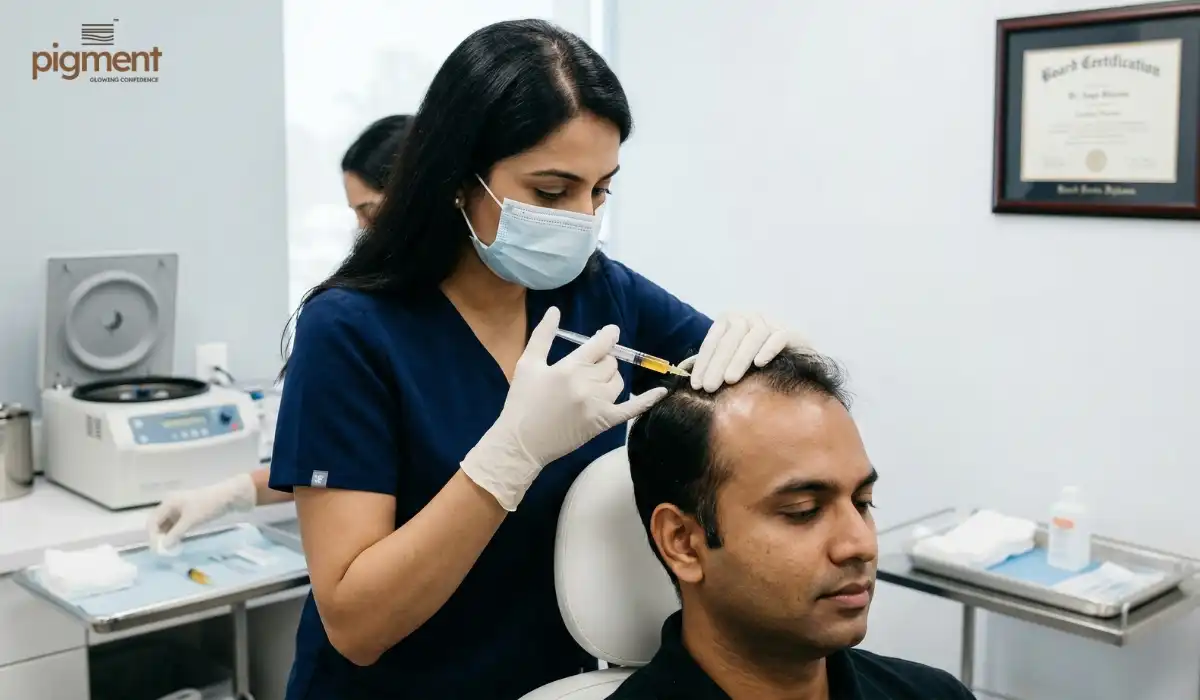
You need to understand the gold standard of modern hair restoration. PRP is the most reliable extreme hair fall treatment available today without resorting to a surgical transplant.
We draw a small amount of your blood and spin it in a high-speed medical centrifuge. This process isolates the platelet-rich plasma, which is packed with fundamental growth factors. We then inject this liquid gold directly into your areas of thinning. These growth factors physically signal your dormant hair follicles to wake up, significantly widening the hair shaft and prolonging the active growth phase.
Clinical tracking in our facility shows that patients who combine PRP with their existing routines see a massive spike in density that topicals alone could never achieve.
Growth Factor Concentrate (GFC)
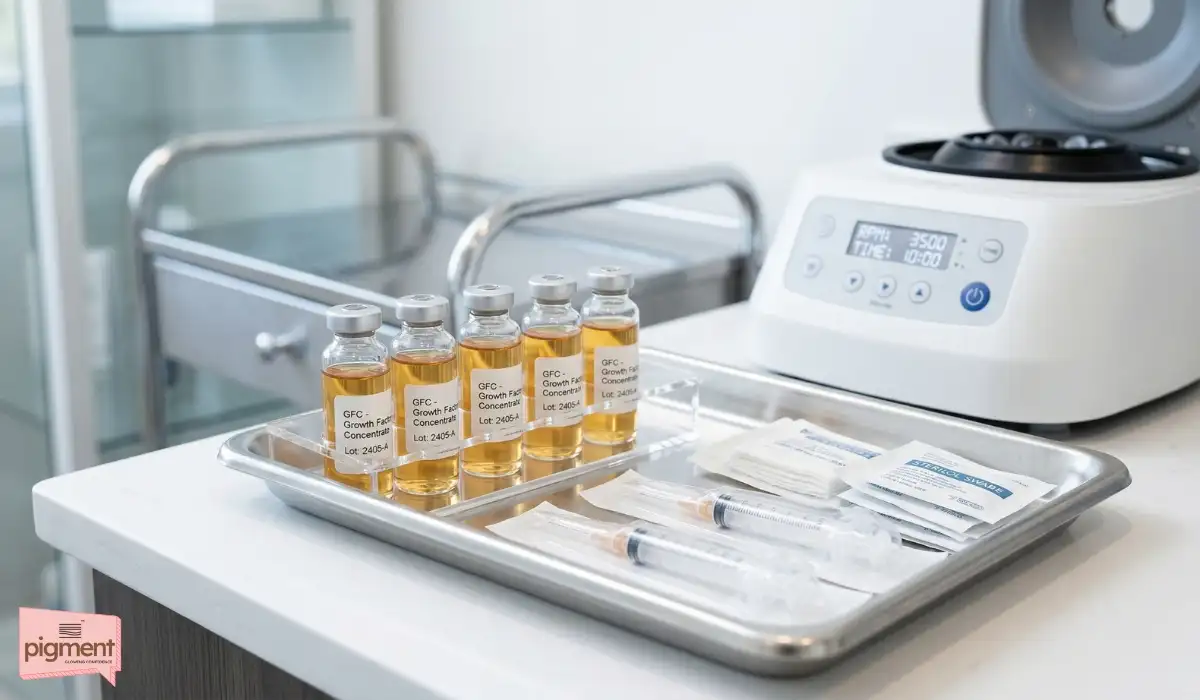
If you have an incredibly sensitive scalp or want the most mathematically precise treatment available, you need to know about GFC.
GFC is the next evolution of PRP. Instead of just injecting platelets, we use a specialized process to break the platelets open and extract pure, acellular growth factors. This means no red or white blood cells are injected into your scalp, resulting in zero inflammation and zero pain. If you are unsure which technology fits your specific shedding pattern, read our comprehensive guide on PRP vs. GFC Hair Treatments to find the exact protocol for your scalp.
Our advanced trichologists heavily favor GFC for patients suffering from severe traction alopecia and late-stage pattern baldness due to its highly concentrated cellular payload.
Minoxidil vs. PRP: Which Treatment is Best for Hair Fall?
We are directly comparing these two methods because you need to understand the return on your investment. Patients constantly ask us: does hair fall treatment work? The answer depends entirely on your compliance and the depth of the cellular repair.
You must stop viewing minoxidil and PRP as equal alternatives. They are entirely different tiers of medical intervention. Minoxidil requires a strict twice-daily application for the rest of your life. The moment you stop applying it, all the new hair you grew will fall out within three months. PRP acts as a deep structural reset. It requires just three to six monthly clinical sessions, followed by a simple maintenance session once or twice a year.
Dermatological consensus confirms that while minoxidil acts as a temporary life support system for weak hair, PRP actively rebuilds the follicle’s structural integrity from the inside out.
Your Strategy for Permanent Hair Regrowth
You cannot cure a biological problem with a cosmetic band-aid. If your hair growth has stalled, it is time to stop buying expensive pharmacy drops and start treating the root cause of your shedding. By transitioning from basic vasodilators to advanced regenerative injections, you can force your dormant follicles back to life. You have the power to stop the shedding and reclaim your natural density.
Book Your Advanced Scalp Reset
Ready to force your dormant follicles back into active growth? Step away from the daily drops and map out a permanent clinical strategy with our experts.
Book Your PRP/GFC Consultation NowFrequently Asked Questions: Upgrading Your Hair Restoration Strategy
Q1. Is Minoxidil the best treatment for hair fall permanently?
Ans: No, Minoxidil is not a permanent solution for hair fall. It acts as a necessary life support system that only stimulates surface blood flow. You must apply it twice daily for the rest of your life to maintain any results. To achieve a structural, permanent reduction in hair fall and visible regrowth, you must upgrade to advanced injectable therapies like PRP which physically repair and rebuild the dying hair follicle at a cellular level. Histological studies consistently prove that while Minoxidil increases surface density temporarily, cellular therapies restore long-term follicular health.
Q2. What can I do when Minoxidil stops working for hair growth?
Ans: When Minoxidil stops working and you hit a growth plateau, it means your underlying follicle miniaturization has overpowered the surface-level topical. You need to immediately graduate from pharmacy drops to an advanced hair fall treatment. This is the critical biological trigger to introduce controlled cellular trauma. We highly recommend Platelet-Rich Plasma (PRP) or Growth Factor Concentrate (GFC). These clinical injections deliver a concentrated payload of growth factors directly to the dermis, bypassing the epidermal ceiling to forcefully restart the follicle’s active growth phase. Clinical data tracks a significant density spike in patients who add injectable therapies after topicals have failed.
Q3. Is there a safe and extreme hair fall treatment that works better than home remedies?
Ans: Yes, Platelet-Rich Plasma (PRP) is scientifically recognized as the safest and most effective extreme hair fall treatment without resorting to a hair transplant. Home remedies like expensive oils and serums cannot penetrate deep enough into the dermis to affect cellular change. PRP utilizes your body’s own healing mechanisms by extracting growth factors from your blood and injecting them directly into areas of thinning. Our internal clinic data, validated by dermatological consensus, shows that controlled medical intervention is the only way to rescue a miniaturized hair root and guarantee visible regrowth.
Q4. How can I control severe traction alopecia and late-stage pattern baldness?
Ans: Severe traction alopecia and pattern baldness require highly targeted, regenerative interventions. You should utilize Growth Factor Concentrate (GFC) for its precision and potency. GFC is essentially the pure, acellular derivative of PRP, offering a more concentrated cellular payload. While PRP is excellent, GFC bypasses all inflammation, ensuring the follicle receives a massive, painless dose of repair signaling. Many patients read our specific guide on PRP vs. GFC Hair Treatments to understand which technology best fits their particular severity. Trichologists heavily favor GFC for these severe cases due to its superior follicular stimulation capabilities.
Q5. Does an advanced hair fall treatment truly work?
Ans: Yes, advanced hair fall treatments based on cellular medicine are scientifically proven to work and reverse significant hair thinning. However, their efficacy depends entirely on direct, precise dermal application. This is not a cosmetic band-aid. PRP and GFC act as deep structural resets, forcing dormant follicles back into active growth and physically widening the hair shaft. Unlike topical Minoxidil which acts as daily life support, injectable therapies provide a foundational, long-term fix that truly reclaims hair density. Every advanced protocol at our facility is rooted in published medical science.