
Written by Pigment Medical Editorial Team | Medically Reviewed by our MD DVL Certified Dermatologist, Pigment Clinics | Last Fact-Checked: June 26, 2026
Key Takeaways
- Pigmentation treatment in Bangalore at Pigment Clinics uses the Jeisys TriBeam Premium, a US FDA approved Q-switched Nd:YAG laser, to target melasma, sun-induced pigmentation and post-inflammatory hyperpigmentation.
- Most patients need 6 to 8 sessions spaced 3 to 4 weeks apart, combined with prescription topicals and strict sun protection.
- Melasma is a chronic, relapsing condition. Treatment controls it, but maintenance and sun protection decide how long results last.
- All clinical laser sessions for pigmentation are performed by our trained technians under the supervision of MD DVL Certified Dermatologists.
- Honest expectations matter: pigmentation lightens gradually over weeks, not overnight, and Bangalore’s UV index demands ongoing protection.
In This Article
Pigmentation is one of the most common concerns we see at our Haralur clinic, and it is also one of the most misunderstood. Patients walk in frustrated after months of trying creams, kitchen remedies and switching cleansers, only to find the patches darker than before. Melasma in particular has a way of returning, fading, then returning again. Often it is timed with summer, a pregnancy or a new contraceptive.
Bangalore makes this harder. The high UV index, year-round sun exposure during commutes, hard water and the heat radiating off laptop screens create a near-perfect environment for pigmentation to flare. At Pigment Skin & Hair Clinics on Haralur Main Road, we treat pigmentation as a medical condition, not a cosmetic flaw. Pigmentation treatment in Bangalore should begin with a proper diagnosis, then move into a protocol supervised by qualified dermatologists.
This guide walks you through what causes pigmentation, why home remedies stop working, how we treat it at Pigment, what it typically costs, and the honest answer to the question every melasma patient eventually asks: will it come back?
What Causes Pigmentation and Melasma and How Is It Diagnosed?
Pigmentation is the darkening of skin caused by excess melanin produced by cells called melanocytes. Melasma is a specific, chronic form of facial pigmentation. It appears as symmetrical brown or grey-brown patches, most often on the cheeks, forehead, upper lip and jawline.
In our clinic, we see four main drivers behind pigmentation in Bangalore patients:
- UV exposure. Bangalore’s UV index sits high almost year-round. Even cloudy days and short auto rides trigger melanocytes.
- Hormonal triggers. Pregnancy, oral contraceptives, thyroid imbalance and PCOS commonly worsen melasma.
- Heat and screen exposure. Infrared heat from cooking, two-wheeler commutes and long laptop hours can aggravate melasma independently of UV.
- Inflammation. Acne, harsh scrubs, aggressive bleaches and unsupervised peels leave behind post-inflammatory hyperpigmentation, often called PIH.
Before any treatment, our MD DVL Certified Dermatologists examine the skin under a Dermlite dermatoscope. This step matters more than most patients realise. The dermatoscope helps distinguish epidermal pigmentation, which sits in the surface layer, from dermal pigmentation, which sits deeper and behaves very differently under treatment. Fitzpatrick skin type, family history and trigger pattern are also documented at this stage. Accurate diagnosis is what separates effective pigmentation treatment in Bangalore from a generic facial package.
Quick answer: Melasma and pigmentation are caused by overactive melanocytes responding to UV, hormones, heat and inflammation. Diagnosis requires a clinical exam plus dermoscopy to identify pigment depth before any laser or peel is planned.
Clinical Treatments vs At-Home Remedies
Most patients have already tried lemon, turmeric, kojic creams, vitamin C serums or over-the-counter skin lightening products before they book with us. Sound familiar? Some of these have a genuine supporting role. None of them treat the root cause on their own.
At-home remedies work on the surface. They can help maintain results and slow new pigmentation forming, but they cannot break down established melanin clusters sitting in the dermis. Unsupervised use of hydroquinone or strong actives is a particular problem. The skin can darken further once the cream is stopped, a pattern called rebound pigmentation.
Clinical treatment works differently. Medical-grade lasers like the Q-switched Nd:YAG break melanin into smaller particles that the body clears naturally over time. Prescription topicals are matched to your skin type. Chemical peels are performed at controlled depths under dermatologist supervision.
Here is how the two approaches compare in our experience:
| Approach | What It Does | Limitations |
|---|---|---|
| OTC creams and serums | Mild surface brightening, antioxidant support | Cannot reach dermal pigment, results plateau in 8 to 12 weeks |
| Kitchen remedies | Temporary glow, mild exfoliation | Can irritate and worsen melasma, no clinical evidence for deep pigmentation |
| Prescription topicals | Slow melanocyte activity, treat surface PIH | Need dermatologist supervision, cannot fully clear melasma alone |
| Chemical peels (clinical) | Exfoliate pigmented layers, even tone | Need 4 to 6 sessions, mild downtime |
| Q-switched Nd:YAG laser | Targets dermal and epidermal pigment, treats melasma | Needs 6 to 8 sessions plus maintenance |
For most patients, the realistic path forward is a combination. In-clinic lasers or peels to treat the existing pigmentation, plus a maintenance routine to prevent relapse.
How Do We Treat Pigmentation at Pigment Clinics, Haralur?
Quick answer: At Pigment, pigmentation treatment is built around the Jeisys TriBeam Premium Q-switched Nd:YAG laser, supported by medical-grade chemical peels and prescription topicals. All clinical laser sessions are performed by trained technicians under the supervision of MD DVL-certified dermatologists, with a protocol tailored to your pigmentation depth, Fitzpatrick skin type, and trigger pattern.
Our approach is layered. We rarely rely on a single treatment because pigmentation often has multiple causes.
Jeisys TriBeam Premium, a US FDA Approved Q-switched Nd:YAG Laser
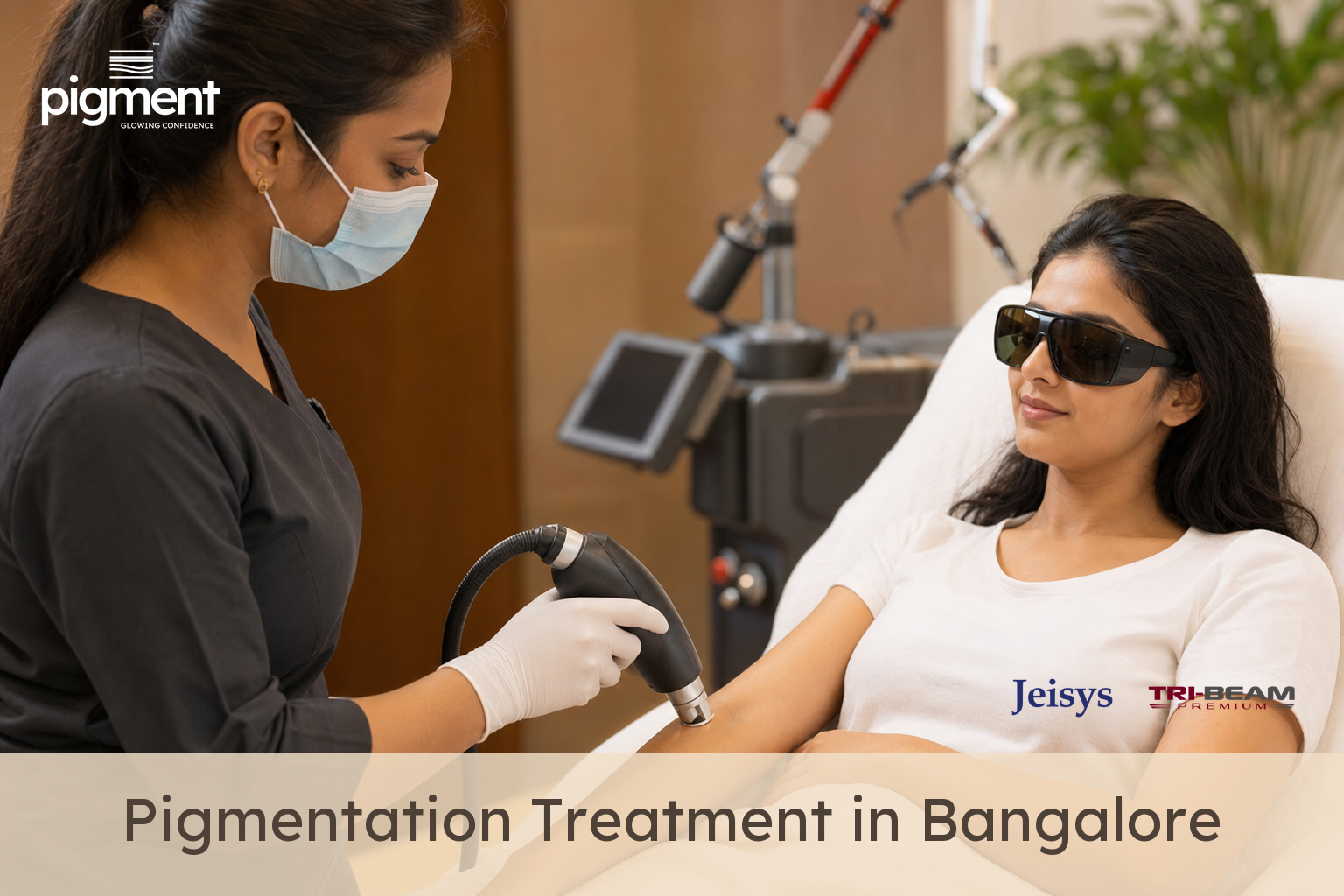
The Jeisys TriBeam Premium is the workhorse of our pigmentation protocols. The Q-switched Nd:YAG laser delivers ultra-short pulses of energy that selectively shatter melanin without damaging the surrounding skin. The fragmented pigment is then cleared by the body’s natural processes over the following weeks.
The TriBeam is well-suited to Indian skin because its wavelength and pulse duration are designed to target melanin while sparing surrounding tissue. Used correctly, it can treat melasma, sun-induced pigmentation, PIH, freckles and dermal pigmentation conditions. Each session lasts around 20 to 30 minutes with no downtime. All sessions are performed by our MD DVL Certified Dermatologists.
Carbon Laser Facial, also called Carbon Peel or Hollywood Facial
For patients with combined dullness, open pores and mild pigmentation, the Carbon Laser Facial is a useful add-on. A thin layer of carbon is applied to the skin and then targeted by the same TriBeam laser. The carbon absorbs the laser energy and lifts away tan, surface pigment and dead cells. Results are visible in the same session with no downtime. We typically recommend 4 to 6 sessions for lasting improvement. These sessions are performed by our trained, certified technicians under medical supervision.
Chemical Peels
Medical chemical peels are used either as a standalone treatment for mild to moderate pigmentation, or alongside laser to accelerate clearance. Peel depth and acid type are chosen based on your Fitzpatrick skin type and pigmentation pattern. Performed by our trained, certified technicians under medical supervision, with the protocol set by our dermatologists.
Prescription Topicals and Maintenance
No pigmentation treatment in Bangalore is complete without a structured home routine. We prescribe tyrosinase inhibitors, antioxidants and barrier-repair moisturisers based on your skin. A broad-spectrum sunscreen with tinted or iron-oxide protection is non-negotiable, because visible light also triggers melasma.
All treatments are performed under the supervision of our MD DVL dermatology team, using only US FDA approved machines. Ready to plan your protocol? Book your appointment.
Not sure which option fits your skin and budget? Book an appointment with our MD DVL dermatologists for a personalised plan.
What Does Pigmentation Treatment Cost in Bangalore?
Pigmentation treatment cost in Bangalore varies based on the type of pigmentation, its depth, the technology used and how many sessions are needed. The figures below are general Bangalore market reference ranges, not clinic-specific quotes.
| Treatment | Typical Bangalore Range (per session) |
|---|---|
| Q-switched Nd:YAG laser (TriBeam) | Rs.3,500 to Rs.8,000 |
| Carbon Laser Facial | Rs.3,500 to Rs.8,000 |
| Chemical Peel | Rs.2,000 to Rs.6,000 |
| HydraFacial (adjunct) | Rs.5,500 to Rs.15,000 |
Most melasma protocols run across 6 to 8 sessions spaced 3 to 4 weeks apart, plus maintenance every 2 to 3 months.
A few factors influence your final cost:
- Type of pigmentation: Epidermal pigmentation usually clears faster than dermal melasma.
- Number of sessions: Stubborn melasma or PIH from old acne needs more sessions.
- Combination protocol: Laser plus peels plus prescription topicals costs more than a single modality, but often delivers better long-term control.
- Skin sensitivity: Patients with reactive skin may need gentler, slower protocols.
For an accurate cost based on your skin, book a consultation.
What to Expect: Your Treatment Journey
Your first visit begins with a detailed history, dermatoscope examination (if required by dermatologist) and photographs for tracking. Our dermatologist explains whether your pigmentation is epidermal, dermal or mixed, and what realistic results look like for your specific case. That conversation is something we take seriously.
Before each laser session, the skin is cleansed and a cooling pass is done. The TriBeam treatment itself feels like tiny warm pinpricks. Most patients tolerate it well without anaesthesia. After the session, skin may look slightly flushed for a few hours. There is no downtime, and you can return to work or college the same day.
For the first 48 hours, we ask you to avoid hot showers, the gym, swimming pools and active skincare. Reapplying sunscreen every 3 to 4 hours is essential. Most patients see visible lightening from session 3 onwards, with the most noticeable improvement around sessions 5 to 8. In terms of a realistic timeline: meaningful pigmentation reduction is typically visible between 8 and 16 weeks from the start of treatment.
Now, the honest part about melasma. It is a chronic, relapsing condition, not a one-time fix. Lasers and peels can fade it significantly, but UV exposure, hormones, heat and skipped maintenance can bring it back. Patients who stay consistent with sun protection and quarterly maintenance sessions usually maintain their results well. Patients who stop everything once they look clear often see relapse within 6 to 12 months. [CITATION NEEDED – verify with dermatologist before publishing]
Frequently Asked Questions
Will my pigmentation/melasma come back after treatment?
Melasma is a chronic, relapsing condition, so a full one-time cure is not realistic. With proper laser protocols, prescription topicals and consistent sun protection, most patients maintain clear or significantly lighter skin long-term. Relapse is most common when sunscreen and maintenance sessions are stopped.
Is the Q-switched Nd:YAG laser painful?
Most patients describe the sensation as tiny warm pinpricks or a mild rubber band snap. The Jeisys TriBeam Premium is well tolerated without numbing cream for most skin types. Any redness usually settles within a few hours.
How many sessions will I need for pigmentation?
Most pigmentation protocols at Pigment need 6 to 8 sessions, spaced 3 to 4 weeks apart. Dermal melasma or long-standing PIH may need more. Your dermatologist will give you a personalised plan after assessing your skin under a dermatoscope.
Are pigmentation lasers safe for Indian skin?
Yes, when chosen and operated correctly. The Q-switched Nd:YAG wavelength is well suited to darker Fitzpatrick skin types common in India. At Pigment, all laser sessions for pigmentation are performed by our MD DVL Certified Dermatologists using US FDA approved equipment.
Who is a good candidate for pigmentation treatment?
Adults with melasma, sun-induced pigmentation, post-inflammatory hyperpigmentation or uneven skin tone are typically good candidates. Pregnant or breastfeeding patients should defer laser treatment. A clinical assessment is needed to confirm the right protocol for your skin.
Ready to take the next step? Book your appointment at Pigment Clinics, Haralur, and get a personalised treatment plan from our MD DVL Certified Dermatologists.